

Introduction
If you compare the price of the same crypto asset across multiple exchanges, you may notice that the numbers are not always identical.
Bitcoin can trade at one price on one exchange and a slightly different price on another. The same can happen with Ethereum and other highly traded digital assets.
At first, this may seem unusual. If the asset is the same, why isn’t there one universal price?
The answer lies in how crypto markets are structured.
There Is No Single Global Crypto Order Book
Unlike a traditional market where trading may be concentrated through specific centralized venues, crypto trading takes place across many exchanges and liquidity venues.
Each exchange has its own:
- Buyers and sellers
- Order book
- Trading volume
- Liquidity
- Market participants
- Execution activity
That means each venue is continuously establishing its own local market price.
The price displayed on an exchange is therefore a reflection of activity taking place on that venue, rather than a single global price generated by one central order book.
Research published in 2026 continues to describe crypto markets as fragmented across centralized and decentralized venues, with liquidity and execution conditions differing between them.
Price Discovery Happens Across Multiple Venues
The market price of a digital asset is constantly influenced by orders entering different trading venues.
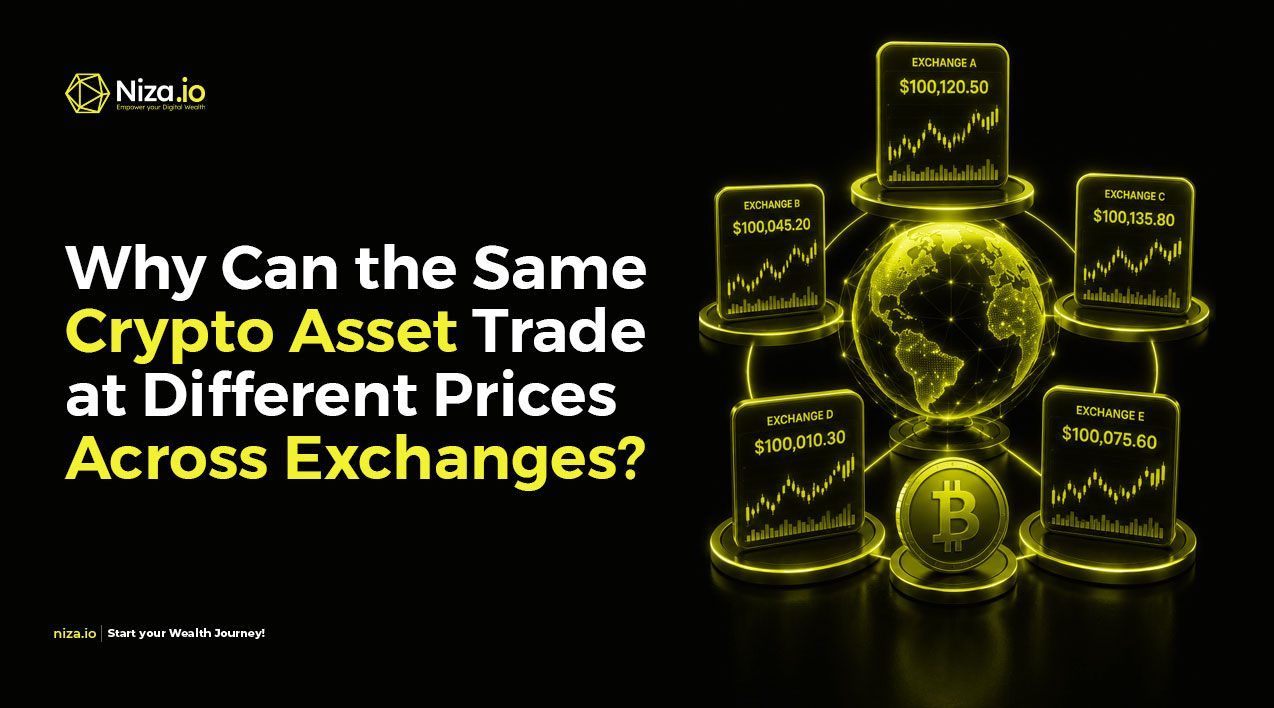
Imagine that BTC/USDT is trading at:
$100,000 on Exchange A
and
$100,050 on Exchange B
That difference doesn’t necessarily mean one exchange is displaying an incorrect price.
It can simply reflect the orders currently available on each venue.
As traders react to those differences, buying and selling activity can push prices closer together.
This process is part of price discovery.
Liquidity Changes the Picture
Liquidity is one of the most important reasons prices can differ between venues.
An exchange with deeper liquidity may be able to absorb larger orders with less movement in the quoted price.
A thinner market can react more sharply when a relatively large order enters the book.
This is why looking only at the displayed price doesn’t always tell the complete story.
Two exchanges can show similar prices while offering very different conditions for actually executing an order.
Recent exchange-liquidity research has highlighted differences in market depth, spreads and slippage across major venues.
The Spread Also Matters
Another part of the equation is the bid-ask spread.
The highest price a buyer is currently willing to pay is the bid.
The lowest price a seller is currently willing to accept is the ask.
The difference between the two is the spread.
Different exchanges can have different spreads because their order books contain different orders and levels of liquidity.
So when comparing prices across platforms, you’re not always comparing exactly the same trading conditions.
Why Don’t Arbitrageurs Eliminate Every Difference?
This is where crypto market structure becomes particularly interesting.
If an asset is cheaper on one exchange and more expensive on another, a trader may attempt to buy on the cheaper venue and sell on the more expensive one.
This type of activity is commonly referred to as arbitrage.
In theory, arbitrage can reduce price differences.
In practice, however, executing across multiple venues involves real-world frictions:
- Trading fees
- Withdrawal fees
- Network costs
- Transfer times
- Available liquidity
- Slippage
- Account restrictions
- Execution risk
Academic research published in 2026 specifically examines these practical frictions in arbitrage between centralized and decentralized crypto exchanges.
So price differences can exist even in highly active markets.
What Does This Mean for Traders?
The important takeaway is simple:
The displayed price isn’t the entire market.
When interacting with an exchange, the relevant questions can include:
- Which trading pair are you looking at?
- What is the current bid?
- What is the current ask?
- How deep is the order book?
- What volume is trading?
- What would the actual execution look like?
The market is not just a number on a screen.
It is the interaction between orders.
The Role of a Centralized Exchange
A centralized exchange operates its own trading venue, matching buyers and sellers within its market infrastructure.
That creates a specific environment with its own order flow, liquidity and execution conditions.
For users, understanding this distinction helps explain why the same asset can display slightly different prices across exchanges.
It also explains why professional market participants pay attention to more than the headline price.
Final Thoughts
Crypto doesn’t have one universal trading screen.
It has a network of interconnected venues, each contributing to price discovery.
Prices can converge through trading activity, but differences can remain because liquidity, order flow, fees and execution conditions aren’t identical everywhere.
The asset may be the same.
The market around it isn’t.
Explore crypto markets on Niza.io.